Invest Appalachia and AFN: Co-Authored Piece on Central Appalachia's Helene Response is Now Live
As our region approaches the two-year milestone post-Helene, rebuilding requires more than short-term relief—it demands sustained, trust-based capital that meets local communities where they are.
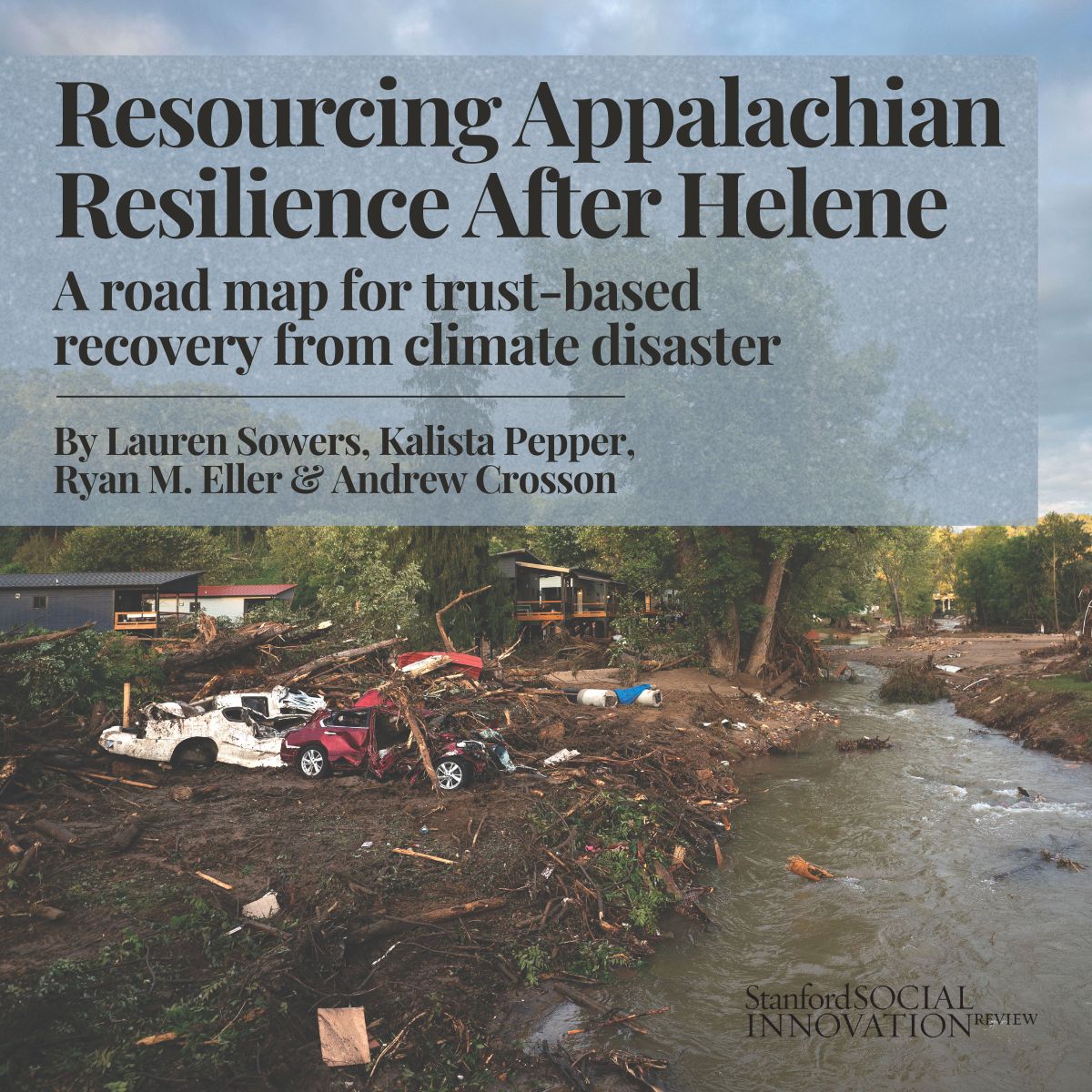
In a new piece co-authored by Invest Appalachia CEO Andrew Crosson and Director of Communications & Impact Lauren Sowers, alongside Appalachia Funders Network Executive Director Ryan M. Eller and Network & Membership Coordinator Kalista Pepper, we break down what effective disaster recovery looks like in the Stanford Social Innovation Review.
Central Appalachia’s Helene resilience story has transpired over two years, but it is generations deep. It’s a story about investing in a community-driven, equitable economic system built to withstand future crises.
An excerpt from the piece:
In Appalachia, trust is often quietly accrued through years of presence, rather than by position or title—something accumulated through enduring relationships, repeated interactions, and shared experience. Communities learn whom to trust by who shows up; who follows through; who exercises sound judgment under pressure; and, most important, who can be counted on when formal systems are delayed, incomplete, or absent.
While trust is often viewed as a “soft” asset, it is operational infrastructure in marginalized economies, even a form of civic power. Any region that wants to survive compounding crises amid disinvestment needs to start investing in it now, before a disaster forces the question.
The architecture of Appalachian recovery offers lessons for any region where postextraction economies meet climate vulnerability. Outside help, when it comes, arrives late, arrives with conditions, and often leaves with something. Rather, it is the neighbors who come first. The networks that responded to Helene were the ones that were generations deep before the storm began.
📖 Read the full piece here: Resourcing Appalachian Resilience After Helene